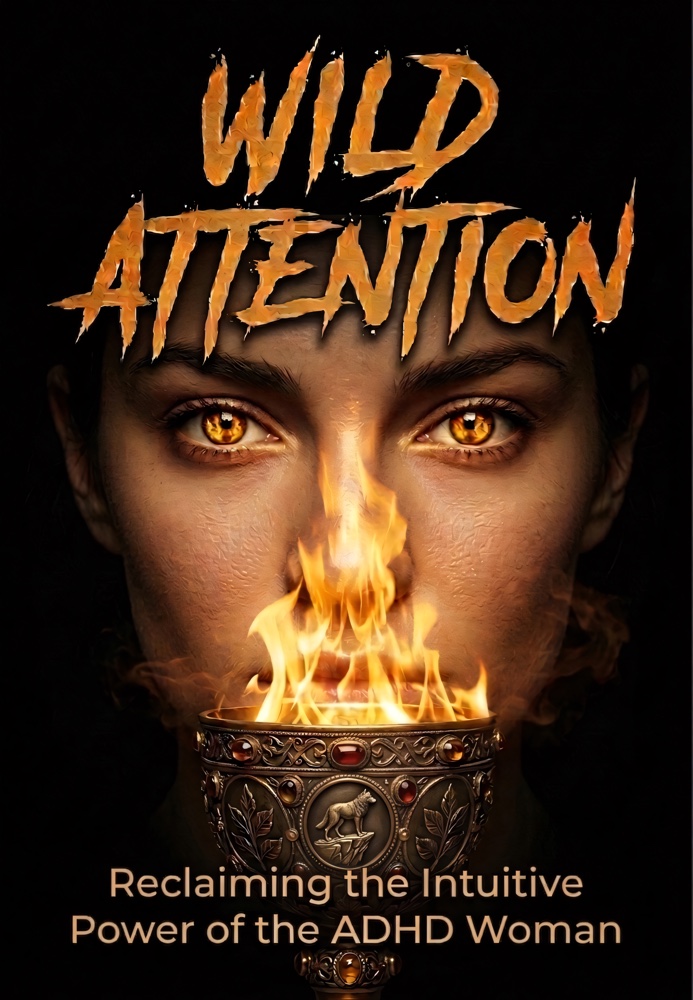
A book for the woman who was called too much

Reclaiming the Intuitive Power of the ADHD Woman
Thirteen chapters. Thirteen old stories. Myth and neuroscience braided together — for the woman who just got the diagnosis, and the woman who is still not sure she believes it.
by David Shimel · Coming 2026
“This book will not teach you to sit still.”
It will not give you a system for your inbox, a hack for your morning routine, or a journal with prompts you will fill out for three days and then lose. It will not fix you — because you are not a broken machine awaiting the correct wrench.
From the introduction
You are sitting in a car in a parking lot and you are not moving.
The engine is off. The coffee in the cupholder went cold an hour ago — you bought it on the way here, the large, because you always get the large, and you drank half of it in the waiting room and then forgot it existed. Your phone has eleven notifications you haven't checked. There is a parking ticket under the windshield wiper.
On the passenger seat is a piece of paper. A string of letters that has apparently been true about you for your entire life and that you learned forty-five minutes ago. The parking lot looks exactly the same as it did two hours ago, and you are not the same person. Or maybe you are exactly the same person, and the only thing that's changed is that someone has given you a different name for why the coffee is always cold and the meter is always expired and you have been tired in a way that no amount of sleep has ever fixed for as long as you can remember.
You are not sure what to do next.
That is where this book begins.
The Naming
They are in direct contradiction with each other, and they are both completely true.
Not small relief — tectonic relief, the kind that moves the plates of an entire life. The thing has a name, and the name is not lazy. It is not careless. It is not why can't you just. There is a reason. The reason has a name — and it is the most merciful sentence she has heard in decades.
Because if this has been true her whole life, then every decision she has made was made inside a condition she didn't know she had. Every memory, every failure, every success she's not sure she earned — suddenly a different story than the one she's been telling herself. And she doesn't know the new story yet.
The Mythic Thread
Each chapter opens with a myth — the Handless Maiden, the Bone Woman, the wolf who was born running — retold for the specific neurology this book describes. The myths walk through the door Clarissa Pinkola Estés opened in Women Who Run with the Wolves, carrying the ADHD woman's brain with them: its particular hungers, and its particular costs.
“The myths are not illustrations. They are the book's other language, running underneath the clinical one, saying the unsayable.”
They are braided with contemporary neuroscience, clinical research, and cultural criticism. Every clinical claim is grounded in peer-reviewed research — and the science is always in service of a felt question: not just what does the research say about emotional dysregulation, but what does it feel like to live inside it.
The Journey
Four parts. Thirteen chapters. You do not have to read them in order — the book will hold.
I
Descent into the Diagnosis
II
Understanding the Untamed Mind
III
Relationships, Work, and the World
IV
Integration and the Wild Road Ahead
Plus three appendices: a resource guide, a screening & assessment primer, and a chapter for the people who love us.
“The exhausted woman, the ashamed woman, the woman who is not sure she believes in any of this — she goes first. If the book cannot hold her, it fails.”— from the introduction
Join the Community
Wild Attention arrives in 2026. Leave your email and you'll be the first to know when it's ready — plus the occasional letter along the way. No systems. No hacks. No noise.
Your address is never shared. Leave anytime.